Showing posts with label waterbuck. Show all posts

Tuesday, December 22

Escaping to Kruger (3) - And back south again


Levaillant's cuckoo

For Parts 1 & 2 of this trip to Kruger please click on these links...

 The Journey North 

Birding in the Parfuri

On our last morning at the Eco-training  camp, and for much of the rest of the day journeying back south to Shingwedzi - it rained, rained and rained.

The animals were all drenched and often looking "miserable, but life in the bush goes on.


Fortunately for me, the rain was not so hard that I had to always keep my car windows closed.

I got damp, but, hey, it's summer in the north-eastern lowveld, so I didn't get too cold.

 What struck me, was how another week into summer, with a bit of rain and more sunshine, the bush had generally got another 100% greener. I hope my pics can show you how much.


At Dzundwini Hill (near Punda Maria) I spent over half an hour enjoying the giraffe, impala and elephant feeding all around me.


These young waterbuck were a little far to get really great pics of, but I really loved the lush vegetation backdrop.


Being early December, there were impala lambs everywhere and not always sheltering away under the bushes.


Another 1/2 hour stop was with this troop of baboons and a small herd of nyala (females and youngsters) sheltering under some of the tall riverine trees along the Mphongolo River road.

They all looked so wet and cold!


On the second day of the journey south, I was based in Shingwedzi Camp, and I only took one, relatively short, mid-day game drive along the river. The weather had cooled down even further so there weren't a lot of large animals out and about, but I got some great birding.
 
These are just the birds that decided to perch in the bushes quite close to me,

Woodland kingfisher

White-fronted bee-eater

African hoopoe


Day 3, found me traveling south to Letaba Rest Camp, and although it remained overcast, the rain had stopped.
 In the morning I saw not much at all, except for this stunning Water monitor lizard at the bird hide.
 
By early afternoon I had hit Nshawu vlei which is a beautiful open area stretching over 20km north to south draining the water run off from the Lebombo range on the eastern border (of Kruger and South Africa). At this time of the year it has sweet, short, green grass, water and lots of animals!
 
 It was a long day on the road. and I was very thankful to have my favourite hut and view of the Letaba River to relax with a glass of wine. A big bonus was the sun breaking through and lighting up the river!

There are impala, waterbuck & birds in view!

As often happens, the weather was clear and sunny on my last morning drive out of Kruger. Of course the temperatures and humidity were exponentially higher.

This old buffalo interrupted his feasting for a brief moment to eyeball me...


It was an amazing trip to Kruger, the first since the pandemic really hit us, and until I can return to working (on safari with clients) in the Kruger I will try to do trips like this more often.

Friday, January 4

October to January, Dry Season to Wet Season - A dramatic contrast

Sunset over the Great Escarpment and the Valley of the Olifants
Since October I've been fortunate enough to have been back on safari to Kruger several times.

It's been a really good re-introduction to safari life and a great reminder of why I love this work so much.

Looking over my photos from the last 3 months I also realised how quickly and dramatically the bush changes from the scorched earth of spring and the drawn out end of the dry season, to the lush green vegetation that seems to appear so abruptly once the rains arrive.

This year, the rains delayed and delayed, but since arriving in late December, they have made up for lost time with endless grey, drizzly days interspersed by frequent deluges.

These photos are some of my favourites of the last 3 months and also show quite clearly the transition from dry to wet..........

Mid October


When we went out on our first afternoon game drive in the Balule, these lions were still chewing on a baby giraffe they had killed much earlier that day.


After dark the cubs were allowed onto the carcase, and once their bellies were full they thirstily gulped water from the nearby waterhole.


Other highlights from our October safari......

The rare Black Rhino - not much nourishing green in that mouthful
Displaying a little aggression on approaching the lodge waterhole
My best photo ever of a Steenbok
Black-backed Jackal
A stately Waterbuck
November

Pied Kingfisher
An amazingly close encounter with a Verreaux Eagle-Owl

Kruger does have some evergreen vegetation, trees that grow on the riverbanks or in wetter areas, giving these birds that lovely green backdrop.

By the end of the dry season one can see the river courses from quite a distance away, the only green visible in thousands of square kilometres.
 
Much to the relief of the browsers (giraffe, kudu etc.) Kruger's acacia trees start coming out in their spring leaf well before the rains arrive. 

For me it's always a slightly bizarre sight - dry, sun-bleached veld dotted with the vibrant spring green of the acacias.

A multitude of different animals at Transport Dam
By the end of November there had been a few days with scattered thunder showers - just enough to get a sprinkling of green grass in some areas, but the large waterholes were still the only places the wildlife could drink.  (there were also buffalo and rhino at this waterhole)

January

And after just a couple of weeks of rain...........
Lots of babies around by mid-summer
This bull elephant was enjoying the lush green grass around & under the bushes

After a night of exceptionally heavy rain, this leopard mother had just caught an impala and was watching her cub enjoy it's meal.


Sunday, February 14

Past and present - photos from the archives

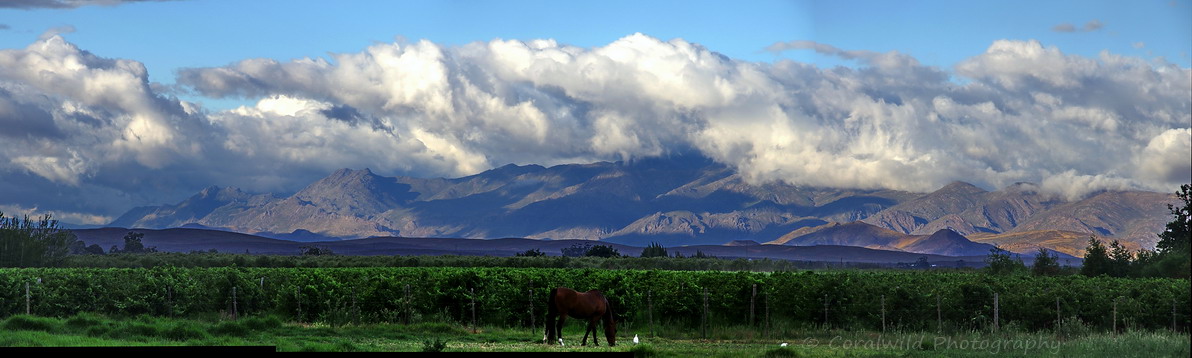
Cape Winelands, view from Nuy Valley - February 2015

Whilst my "gypsy" lifestyle is on pause I've been revisiting my photo archives and realising just how much ground I have covered over the years!

This again is a collection of photos that I have posted on my Coral Wild Snapshots Facebook page over the last few weeks, in no particular order. I hope you enjoy both the images and my recollections!


Most of our vulture species are "threatened" or "endangered".

However within a large conservation area like Kruger National Park one can see the more common species fairly regularly.

This particularly handsome bird, however, is a rare and exciting sighting. It is a Lappet-faced vulture (Torgus tracheliotus) - our largest.

That huge, strong beak is quite capable of tearing the toughest skin on an animal carcase open!

Kruger National Park, November 2010

 
A sunset across Table Bay, seen from Maestros on the Beach, Milnerton - November 2015

Having been introduced to this "restaurant with a view" by Cape Town cousins, I often book our "end of tour" dinner here.

The food is great and our international guests are always blown away by the sunset over Table Mountain, followed after dark by the twinkling lights of Cape Town reflected in the Bay.


Lake Panic Bird Hide is one of my favourite spots in Kruger.

It's a great place for birding, and if one is lucky, hippos and crocs can be really close. Other times I've seen bushbuck, baboons and elephant there.

Early in the morning the lighting can be really challenging for photography, but this Goliath Heron flying past is still recognisable :) -  September 2009


When I visited the US North West and Vancouver Island in 2007, I was "blown away" by the vibrant displays of flowering broom.

I was repeatedly assured that it was an invasive alien plant and the bane of both farmers and conservationists.

That didn't keep me from photographing it at every opportunity and admiring it (silently after the first few lectures!!;))

Vancouver Island, May 2007

SA Agulhas II - Feb 2016


This last Thursday morning I was at the V&A Waterfont, Cape Town, seeing my tour guests on to the Robben Isl. ferry.

The lighting was cool & misty and I couldn't resist spending an hour or so taking some pics.

I was especially excited to see South Africa's Antarctic supply and research vessel, the S.A. Agulhas II enter harbour.

Seeing ships like this really stimulates my wanderlust.


During this last tour, we had a very wet day at Tsitsikamma, yet again.

I suppose that's why it has such wonderful forest.

Anyway despite the steady drizzle I went for a walk on the Goesa trail, of which the highlight is the tree ferns.

I had a good time trying to capture the rain dripping off their fronds.


And for an abrupt change in subject matter, date and colour, here's a photo I took in New York City in June 2007.

Editing the image from color to B&W produced a more dramatic picture, I think!


Keeping to the B&W theme, I edited a whole lot of distracting green from this image of a Nile crocodile to highlight the beauty of it's skin patterns.

This was taken in Kruger National Park in August 2015.


And back to colour for this photo taken of handsome, young and male Water Buck.

Taken in Kruger in January 2013, it shows how lush Kruger can be in a good wet season - not how it's looking right now!


Thursday, April 17

An Autumn Safari Photo Update

Elephant on the Sabie River
April is autumn in Kruger National Park, and a time of unpredictable weather, lush green and gold bush, and variable wildlife sightings.

We were definitely more lucky than many however and had some really amazing encounters over the days we spent in Kruger. On one particular day (thanks Jaime & Anthony!!) we had great quality sightings of lion, black rhino, cheetah, buffalo, zebra, giraffe...... and the very next morning on our way out we had three leopard sightings with 4 different leopards!!
So after an amazing first 2 weeks of April, I'm taking a break from safari work for the next 6 weeks to explore a little bit of Australia and visit friends and family there.

Therefore my next posting won't be until June when I will share with you some of my Australian experiences!

Nile Crocodile


Pied Kingfisher


More riverside sightings......


A young Kudu antelope

Lionesses getting ready to hunt


On cloudy, windy days many of the herbivores congregate together out in open spaces where they can keep a better look out for predators.

Giraffe, Water buck and Zebra

And two VERY special sightings......

Cheetah also looking out on this cool windy day......


Hippo making a tactical retreat from a Black rhino


The first of the four leopards seen in our first hour of the morning drive


This Leopard Tortoise was on a mission to get somewhere......


The intent gaze of the Brown Snake Eagle