One of my most enthusiastic blog
followers, who never failed to ask when my next posting was due, left
this life last Monday.
John was a fellow adventurer,
scuba diver and lover of the wilderness, including Kruger National
Park. During trips to Truk Lagoon, Namibia & Botswana and many
other adventures in Southern Africa, John and Rose, often with their
kids Alex and Fran, were camp-fire companions, diving buddies and
good friends, sharing tall stories over many a glass of good wine.
John will be sorely missed.
In remembering and celebrating John's
life I thought I would share with you some of the more memorable
places and animals in the Kruger National Park that we both loved.
(Most of the following photos I've
published previously so for those of you that are regular followers
and/or regular Kruger visitors (like John was) I'll be giving you a
trip down memory lane as well!)
The South-East
Stretching between
the Sabie River in the west and south and the Lebombo Ranges on the
eastern border are the open basalt plains so beloved by wildlife
photographers, game spotters and any tourist who revisits Kruger.
Exciting wildlife encounters are almost guaranteed in this region and
I've certainly seen cheetah here more often than anywhere else. This
is also where one can find the larger herds of “plains” game –
zebra, buffalo, wildebeest and even giraffe.....
 |
| looking south on the H10 - Muntshe Hill in the distance |
 |
| Cheetah on the look-out |
 |
| Giraffe coming down to drink |
 |
| Rhino & buffalo uneasily sharing a small patch of scarce shade |
Sunset Dam
Just outside Lower
Sabie Rest Camp and still in the South-East, this waterhole produces
great sightings summer or winter, early morning or in the heat of the
day.
 |
| Dozens of hippo and scores of crocodile appear to cohabit quite peacefully |
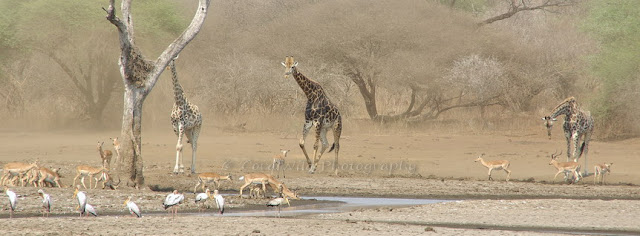 |
| A dusty, dry end to the winter, and water is scarce....... |
 |
| Yellow-billed Stork and Nile Crocodile |
The South-West
South-western
Kruger is a rolling landscape of prominent granite koppies, deep
drainage lines and tall grass growing thickly through the woodlands.
Animals abound here too, but are so much more difficult to spot and
photograph. So the best time to visit this part of the park is during
our dry winters.
 |
| Impala Lily at Malelane Gate |
 |
| Blacksmith Lapwing at Biyamiti Weir |
|
|
Buffalo and giraffe, both seen on Doispane Road........ during two totally different seasons........
There are lots of lion in the south of Kruger, but they don't seem to be that fond of the long grass either.
So we often see them relaxing on the cool sand of the drainage lines (dry river beds).
Lake Panic Bird
Hide
Situated close to
both Skukuza Rest Camp and the Kruger Gate, this bird hide can become
uncomfortably busy, but very early in the morning, mid week, it's
almost guaranteed to be quiet with great sightings of all types of
animals – not just the birds.
 |
| Keeping a close eye on us...... |
 |
| Both birds &terrapin enjoy perching on hippo, but only whilst they're sleeping! |
 |
| Dragon flies are very difficult to photograph! |
Mazithi Dam
Located north of
Tshokwane Picnic site, on the main north-south road in Kruger,
day-visitors to the southern region rarely get to this waterhole.
However, during my early years guiding in Kruger, most of our safaris
involved staying in both Skukuza in the south and Letaba in the
north. On the day we travelled between those two camps we almost
always had great sightings at Mazithi Dam – including the best lion
kill sighting I've ever had.
 |
| During the dry season the waterholes teem with wildlife |
 |
| and during the hot summers they are a great "swimming"pool |
The Central Plains
I've heard South
African visitors compare this region of Kruger to a zoo. Which is not
exactly a compliment!! However, for frequent and great sightings of lion,
buffalo and other plains game, it's hard to beat this area located
around Satara Rest Camp.
 |
| Plains Zebra during a good summer/wet season |
 |
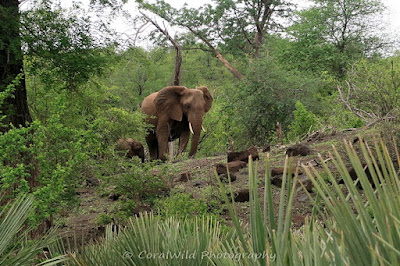
| Elephant & buffalo, during the winter/dry season |
The Rivers
 |
| River reeds in the Sabie River are acceptable food during the dry season |
Kruger National
Park lies between the massive eastern escarpment of Southern Africa,
and the warm waters of the western Indian Ocean. So it's no surprise
that a half dozen of South Africa's infrequent perennial rivers flow
through the Park. Whether their banks are teeming with wildlife or
appear totally deserted, the rivers always trace richly green,
meandering lines through the mostly dry savannah.
 |
| Sabie River, Feb 2009 |
This bridge is designed for floods but for several years now we've had much bigger floods which also damage the high bridges, roads and rest camps........
 |
| Elephant crossing the Letaba River (most favourite pic ever!!!) |
 |
| The Olifants River - many of the big trees have been washed away in floods since 2008 |
 |
| Boababs are a prominent part of the northern landscape |
The North
Further from our
main population centres and mostly covered in semi-arid, mopani,
shrub savannah, the north of Kruger is much less visited by tourists,
including myself and John on his frequent forays into Kruger.
I would like to
spend a lot more time here, and in the past I have had some amazing
wildlife encounters too. The bird life during the wet, hot summer
months is also quite spectacular.
 |
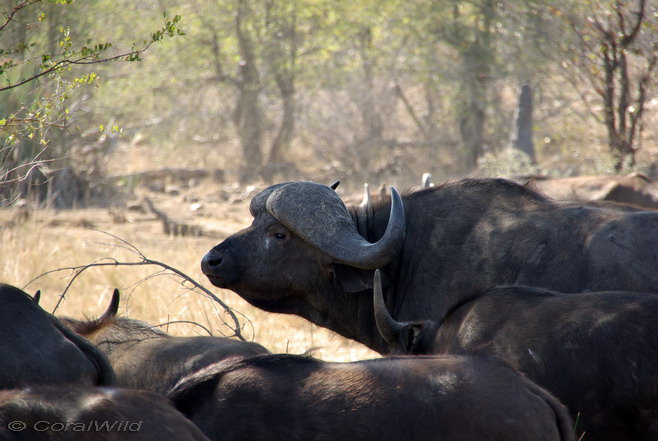
| The size of the buffalo herds in the north are legendary. |
 |
| and where there's buffalo, there are also lion....... |
And to conclude this epic posting...........
There are many, many more “favorite”
spots of mine in Kruger. Too many for a single posting. They can also
change from season to season, year to year.
But I've tried to focus this posting on
those areas that John would have also visited, and to remember him as
I do so.
Farewell John. Thank you for all the
great times we shared together. Those memories will always be
treasured.