Showing posts with label tsessebe. Show all posts

Tuesday, March 22

Mokala National Park - A gem of semi-arid savannah


Situated only 20 kilometers south of Kimberley, the Mokala NP is the newest of the South African National Parks.

It has 3 of the Big 5 African mammals, but it's primary focus is the rare antelope of Southern Africa.

This image is taken looking south-west over the open grasslands of the Lilydale section towards the dolerite hills and bushveld of the Mosu section. 

Note the red kalahari sand in the foreground.

On my first full day in the park I had wonderful sightings in the grasslands.......

a solitary Gemsbok (Oryx)
 

Roan Antelope
 

I spent some time at the lookout point over this waterhole in the middle of the grasslands, and had a herd of Eland antelope run past, without pausing, and then this small group of Tsessebe run down to the water.

 Most of the summer rainfall areas of South Africa have had a really good season this year and the grasslands were lush with most of the antelope looking fat and in good condition.

Eland

Tsessebe

Later in the morning I went south-west to the bushveld and saw many more tsessebe, giraffe, springbok, zebra, warthog and so on.

I also got a punctured tyre!! - the camel thorn trees in this part of the world have vicious thorns!!

Tsessebe

Tsessebe female and calves


Plains zebra and a midday drink
 

On day 2, after getting my tyre fixed at the nearby little settlement of Modderrivier, I had another great day in Mokala. 

This time I went meandering through the dolerite hills and valleys, which had abundant game, and then on west to the far side of Mokala, seeing more game in the flat, lush, thorn tree park lands.

Warthog close to camp

Buffalo sheltering from the heat


A herd of springbok coming down to drink.


Red hartebeest

Plains zebra

Gemsbok (Oryx)

Giraffe


I would definitely like to visit Mokala again, and perhaps stay in the other rest camp, Mosu, which is located in the hilly southern section.

I can also recommend Lilydale camp where I stayed this time. It's on the high bank above the Riet River and has glorious views. I include below, the view from my chalet's deck at 3 different times of the day.

Early evening and sundowner time

 Clear skies, and my first ever attempt at photographing the stars!

Dawn on my last morning


There had been some distant wildfires the previous day, so a little smoke in the atmosphere produced these wonderful colours the next morning.

This little gem of a park is well worth visiting. The official website recommends a minimum of 2 nights, but I spent 3 nights and had no time to get bored. 

So on your next road-trip between the south and north, or west and east of South Africa, plan to stop here for a few nights.


Tuesday, October 7

Those elusive animals of Kruger National Park

An uncommon sighting, Common Reedbuck in a typical pose

If you want to know what's really hard to find in Kruger National Park you just need to watch out for a guides over-the-top response to an animal (usually of a smaller size) sighting.

It's unusual for any first time visitor to Kruger or the African bush, to know what's common and what's rare. Muddling the issue, animals that are rare in Kruger are not always uncommon in other National Parks in Southern Africa, and animals rarely seen "in the wild" can often be seen scavenging in & around human habitation (too influenced by humans to be truly wild in my opinion).

And then to confuse things further, one can have a month like I did in September where I saw more Serval and Honey Badger over just a few weeks than I have seen in 30 years of visiting the bush and 7 years of working in Kruger.

So going back to my opening paragraph - look out for the guides reaction..........


At the end of August I saw my first Sable Antelope for the year. The view was not even as good as this one (pic taken in 2009) and my clients were quite puzzled by my exclamations over a rather obscure dark blob in the long grass.......


Tsessebe near Phabeni Gate


Tsessebe are rare in Kruger, although on a safari back in 2008, Allison, Simon and Lu didn't believe me at all after seeing these graceful antelope on every game drive we did out from Mopani Rest Camp......


Sharpes Grysbok


The Sharpes Grysbok is only found in the far north of Kruger (although I have seen it near Mopani). But even there, it is hard to find. This was my last sighting - September 2011 (and also the last time I was that far north!).


Common Reedbuck


And back to the not-so Common Reedbuck. Not a particularly dramatic looking antelope so my clients are always a little puzzled as to my excitement! We saw a small family herd a few weeks ago on the burnt veld near Pretoriuskop, but before that I hadn't had a good sighting for several years.


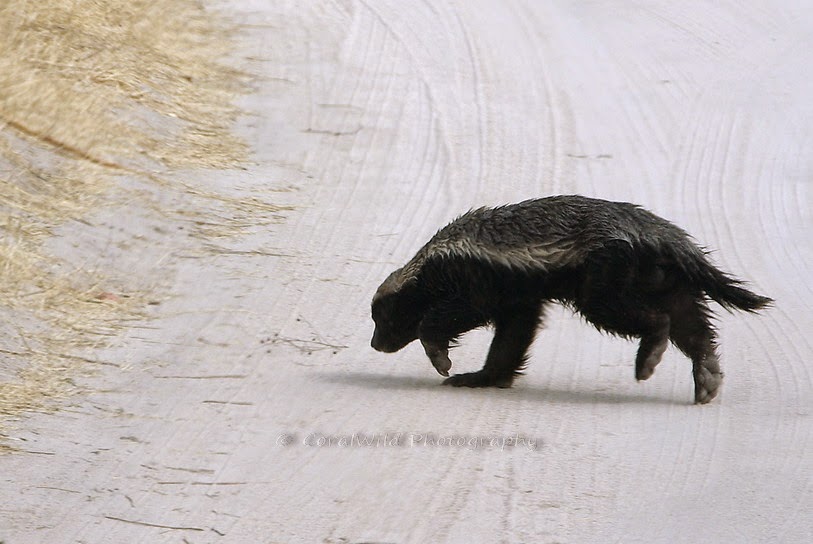
The most exciting action I had in the last two weeks was 4 different sightings of Honey Badger. In Kruger I had only seen these famous, courageous  creatures twice before!

At both Satara and Orpen Rest camps they upset rubbish bins and raid kitchens and can a be a real nuisance - but to see them acting more naturally in-the-wild is most uncommon!


Note the distinct markings on the back of Serval ears


And so to the predators............

Most visitors understandably know about and want to see Africas large cats - lion, leopard and cheetah.....

Most guides and regular visitors to the bush get really excited about Serval, Caracal and African Wild Cat - the "small" cats of Kruger.

I still haven't seen caracal in the wild and have only had a handful of partial sightings of African Wild Cat.

In September we had two great sightings of Serval (4th and 5th lifetime sightings!)
Serval

When I spotted my fifth Serval, sitting calmly on the side of road we all almost fell off our seats I braked so hard.


Caracal
African Wild Cat


The list of Kruger animals that I'm still to find is long - Aardvark, Pangolin, Roan Antelope, Eland (in Kruger), many of the birds, reptiles, snakes.......... but what's life without some challenges?

Saturday, October 27

Zululand – from Zebras to Whales, Owls to Twinspots

I've been meaning to post about Zululand for sometime now. For the last four years I have been fortunate enough to guide a safari each spring/early summer to this beautiful part of South Africa.

In actual fact, the main reason I've just been back there is due to extolling its wonders to Dave and Jean, whilst they were on safari with me in Kruger in late 2009. So this year, they returned and asked me to guide them on an exhilarating 10 day exploration of this amazingly diverse province.

Hluhluwe-iMfolozi Game Reserve

Picture in your mind - steep, grassy mountain sides; dense cool shady forests; crashing Indian Ocean rollers; endless silver beaches; colourful coral reefs; glittering lakes, lazy rivers and reedy marshes; and in-between, around these carefully conserved wilderness areas, the scattered rural homesteads and settlements of the Zulu and Shangaan people and the extensive sugar, pineapple and eucalyptus plantations of “big” agriculture.

Nyamithi Pan, Ndumo Game Reserve

A province of contrasts, a modern melting-pot of the low-intensity but persistent competition for the rich, rain-endowed rolling landscape, between people and wildlife, big business and traditional practices, conservation and development.......

For many years, this part of South Africa has been little known except to South Africans themselves, but international visitors who want to experience Africa beyond the “big 5”, are growing in numbers.

Cape Vidal
The destinations roll off the tongue – the Elephant Coast, Maputaland, Ithala, Ndumo, Sodwana, uMkhuze, iSimangaliso, iMfolozi, Hluhluwe, St Lucia, Cape Vidal......

And so.... to the safari itself......

The rains came early this year, so for October the country side was unusually lush, with wild flowers scattering colour over every open grassland, and woodlands intensely green with the bright colours of new leaf. The pans, lakes and rivers were all full and muddy brown and the skies were mostly grey, black and white with mists and thunderstorms.

The mammals, birds, insects and reptiles, thriving on this early release from the privations of late winter could be seen anywhere you looked and we had some really memorable experiences. These are just a few of them:-

African Wood Owl

A Marsh Owl perched on a fence post next to the roadworks – a first sighting for all of us, and then the very next morning, another first, an African Wood Owl perched deep in a forested mountainside going down to the Phongola River;


We saw at least one (usually more) White Rhino on every day of this safari;


A tense, bumpy, slippery 20 kilometre drive, on deeply muddy roads into Ndumo, culminating in a wonderful sighting of giraffe soon after entering;


Zebra at uMkhuze


An hour, plus, sitting enraptured in the car park of an uMkhuze hide, watching Blue waxbills, Yellow-fronted canaries, Pink-throated twinspots, Golden-breasted buntings, Green-winged pytilias, White-browed scrub-robins, Fire finches..........;

A leopard dragging it's antelope kill away into the thickets close by;


Morning on the beach


Seeing hump-back whales breaching against the sun rising over the Indian Ocean;

Coming back to our log cabin after a long day out bird and animal watching to find all our bread and bananas scattered into crumbs by invading monkeys;

The agile bats whizzing around our heads, inside the cabin, catching insects attracted to the lights;

 
The magnificent, stately Kudu bulls of Lake St Lucia Eastern Shores;


Two large crocodiles patiently stalking warthog and bushbuck just in front of the hide (not successful whilst we were there);


On a rare sunny day, vultures, eagles, kites filling the skies above the rolling iMfolozi hills;

First hearing and then spotting a Gorgeous bush-shrike in a thicket right next to the road;

Picnic breakfast on the banks of the Hluhluwe River;


 First, one large family of elephants, youngsters digging holes, chasing each other whilst mothers calmly carry on demolishing bushes and pulling lush grass. 


Then as we carry on up the river valley, more and more groups, herds, families of elephant, young males sparring, youngsters flopping down on river banks, older males deep in the trees up the hill sides, stately matriarchs with babies hugging their flanks........


And our last morning, on the open grasslands of Ithala, seeing Secretary birds, Blue crane, Bald ibis, Ostriches, Lanner falcons, zebra, rhino, Tssessebee, Red hartebeest, warthog......

Tssessebee in the flowers

Blue Crane (our national bird)

Hartebeest and Wildebeest

A glorious finale to an unforgettable 10 days.

Thank you Jean and Dave!


PS. The company that organised this particular trip now offers 7 day Zululand Explorer packages, so if any of you are inspired to visit Zululand after reading this post, please contact me and I will put you in touch with them.