Showing posts with label Hwange. Show all posts

Wednesday, March 27

Haunting Hwange (3) – A Mopani Spring


Desolation, despair, death.

Skeletal trees reach
Stunted bushes crouch
By parched, muddy puddles
The waterholes of Hwange.

Desolation, despair, death.
Vultures soar, wheel, dive
Hazy, cloudy skies
Over shadeless, naked earth
The pastures of Hwange.

Desolation, despair, death.
Ribcages etched
Dry skin sagging
On just alive bodies
The elephant of Hwange.

Desolation, despair, death.
Bleached bone, carcass stink
Hyaena whoop, lion roar
Each starless dawning
The graveyards of Hwange.

Desolation, despair, death.
Lightning flashes,
Thunder grumbles
Wet earth scents the air
The spring storms of Hwange.

Resurrection, hope, life!
Puddles fresh in hollows
Green fuzz on bare slopes
Red butterfly shoots
Mopani spring in Hwange!


Monday, February 11

Haunting Hwange (2) - Masuma Dam

In Haunting Hwange part 1 (read it here) I described our journey into Masuma Dam, Hwange, Zimbabwe, and our first evening spent there.
 
Masuma Dam - hide and camp seen from "main" road

In all we spent 4 nights at Masuma Dam. The original plan had been for 2 nights but we realised within the first hour what a special place this was. Radio calls between our camp attendants and the office at Sinamatella Camp established that we could spend an extra two nights provided we travelled to Sinamatella to pay the extra bucks.


Our camp

In Hwange, there are camping “facilities” in the 3 main camps and in addition there are three or four picnic / camping sites based at waterholes. Masuma Dam was one of these.

It was located on the “main” thoroughfare between Robins and Sinamatella Camps in the north and west, and Main Camp and the road out to the rest of Zimbabwe in the east. Admittedly we did not spend all day in camp, but during the three days that we were there we only saw 3 other vehicles come by on that road – of which only one was other tourists.
Meves Starling
A beautiful Emperor Moth

The camping ground, hide and dilapidated shower / toilets were kept spotlessly clean by the two attendants, MyBlessing and Thabeni, with extremely few resources and back up from the Park management. They get paid so little that they cannot afford to buy shoes or much in the way of clothing, and one can't even guess how long it has been since they were provided with uniforms.


Nevertheless they were cheerful and hard workers and a poignant reminder for me of just how different the culture and attitude is generally, north of the Limpopo.

On the evening of our arrival, the water pump for the waterhole had started giving trouble, and lacking any basic tools (like a monkey wrench) they were delighted to see us, so that they could borrow the necessary and sort out the pump the next morning.

MyBlessing & Thabeni off to fix the pump

As mentioned in my earlier posting we had wonderful rain on our first night, obviously the first in a long time, and after that it rained / stormed every afternoon we were in Hwange.


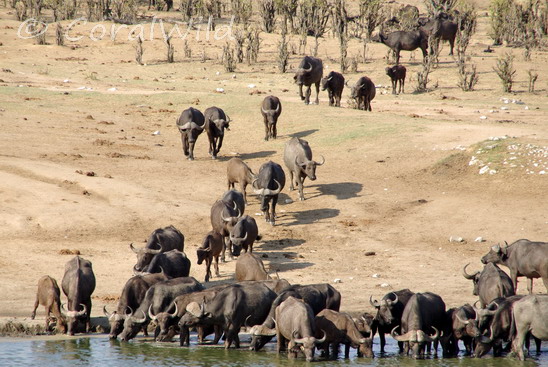
Whether it was the rain, or our noisy, human, presence close to the waterhole, we had no more visits from elephant during daylight hours. One large buffalo herd came in on day 2, but apart from the hippo squeezing together in the small remaining puddle we saw no more mammals at Masuma Dam. We heard hyena and the hippo every night, lion once and the elephants came back for a very noisy drink late one night, but the birds and other creatures kept us entertained most days.


Too many hippos in too little water!


Marabou Stork

Saddle-billed Stork


And of course the sunsets over the waterhole were spectacular every night........


Wednesday, January 30

Haunting Hwange (part 1)

As many of you know I went on a 4 week overland trip through Botswana, Namibia, Zimbabwe and South Africa in late 2011. I promised then to post more about that trip, so this is the first in a series of postings about our stay in Hwange National Park, Zimbabwe, a very special place, full of ghosts......


It was just past noon on a baking day in November that we finally cleared the border posts at Pandamatenga and entered Zimbabwe.

We had packed up camp in Kasane on the Chobe River earlier that morning and had had a fairly smooth drive south, until we hit the Zimbabwean border post.

I've learnt, from long experience, that border posts, especially in Africa, are best approached in a relaxed and patient manner. There is never any point in being uptight or aggressive with officialdom - they have all the "power".

Well this time, we had a small escalation over a minor problem, but fortunately after a bit of stress on everyone's part we got through with only a slight delay.

This was the first time I had been back to Zimbabwe in 4 years, and the first time back to Hwange National Park, (on Zimbabwe's western border) since 1987. So I was very excited!

Facing us was a 100 kilometre drive on dirt roads of unknown quality, so once we were well out of sight of the border we found a patch of shade to stop and have a leg stretch, drink and lunch.

Hans and Bud

Until we got to the Nantwich Gate into Hwange the roads were not too bad, a few rough rocky patches here and there and some stretches of corrugations. The landscapes were beautiful and where they hadn't been burnt there was still quite a lot of vegetation to be seen.

We were also very lucky to spot a distant herd of Sable antelope plus giraffe and impala.....

Lala Palms in the Matetsi Hunting Area


Approaching the Nantwich Gate


Hwange!

the north west part of Hwange was originally the Robins Game Sanct.


Checking in at Robin's Camp we were struck by the dilapidated infrastructure. Windows broken, thatched roofs slipping off, no working toilets. At least there was running water at an outside standpipe. We didn't explore further into the Rest camp as we were running out of time to make the final 40 kilometers to Masuma Dam, our camp for the next 2 nights.

The roads were only washed out in a few places, road signs were still in place at most intersections and the elephant, impala, kudu and buffalo we did see were not blocking our way, so we pulled into Masuma Dam camping/picnic site just two hours later, soon after sunset.

All plans of setting up camp were immediately postponed as we saw a herd of elephants jostling at the drinking trough immediately in front of the hide.


They were gaunt, obviously very thirsty and totally oblivious to us sitting just a few metres away.

We were also thirsty (maybe not so hungry) and we enjoyed our "sundowners" whilst watching all the action.

As the eles silently drifted off into the gloaming, we got back to our hastily parked vehicles and started setting up camp before the night got totally black.

A couple of hours later after enjoying our supper cooked over the camp fire, the heavens opened with a mighty flash and crash and we dashed for our tents.

Plans for the rest of our stay in Hwange could wait until the morrow......


Wednesday, December 7

An overland adventure (Part 2)


At Chobe we bid farewell to four of our companions who departed on the long road home to Johannesburg.

That left just 6 of us to go on to Hwange National Park in Zimbabwe. The distance was not far, but the last 100km to our campsite was dirt road (track in some places) and we eventually arrived at our camp (with waterhole) just before sunset.

As we arrived a herd of dusty, gaunt elephant were jostling for water at the trough just below the hide. We spent a wondrous half hour watching these giants of the bush, just a few metres away from us. Then as darkness fell we set up camp and started cooking our supper on the fire.


Any thoughts of a leisurely nightcap watching the flames die down were blown away as we were chased into our tents by a huge thunderstorm. It crashed and flashed most of the night and we rose to a clear rain washed morning.

I will write another time of the amazing transformation that the mopani tree country went through over the next four days of blazing sun, sticky heat and nightly thunderstorms.

The most immediate impact was that the elephant vanished into the far reaches of the bush, no longer totally dependent on our waterhole. But we weren't on this trip to only look for animals. For the time we were there, we were the only humans at this waterhole with it's three resident hippo, one crocodile, visiting birds and occasional larger animals.

The word “peace” is really totally inadequate to describe our stay in Hwange. 


Exploring Hwange


Sundowners at our own private waterhole

Packing up our camp on the fifth day, we all vowed that we would return, some day......

Then it was back to Botswana (over that 100km of dirt road again), and the town of Nata. We didn't stay more than a couple of nights here as with no water in the Sua Pan, there were no birds to see. We did go out onto the pan to get a “feel” for the place, and had the lookout point all to ourselves for most of the afternoon until a noisy overland tour bus arrived to disturb the peace.....

I would love to come back here some day when the flamingos are here – apparently a very unpredictable event!

Bud and Cath at Sua Pan

From Nata, we took two days travelling to get to Mapungubwe National Park in South Africa. This is where we decided, on the spur of the moment, to spend our last 3 days of the trip.

On the road, Botswana

A typical Botswana road........


 What a contrast!

In addition to the rugged, red rock scenery,gigantic baobab trees studding the plains and the wide sand filled Limpopo and Shashe Rivers, we also had our first rainy days of the entire 4 weeks. As with Hwange, this meant that we had to search for animals everywhere except at the waterholes.

But it also meant having some real fun on the muddy tracks. I had thought my car was looking quite dirty before we got there, but I drove it back to Johannesburg with a very thick coating of mud!

Mapungubwe

Vervet Monkey

Woodland Kingfisher


Our last camp on this trip


So, that was the end of that adventure.......

Four weeks, 6,000 kilometres, four countries, countless animals, many “new” birds, friendly people, spectacular landscapes and memories to last a lifetime.